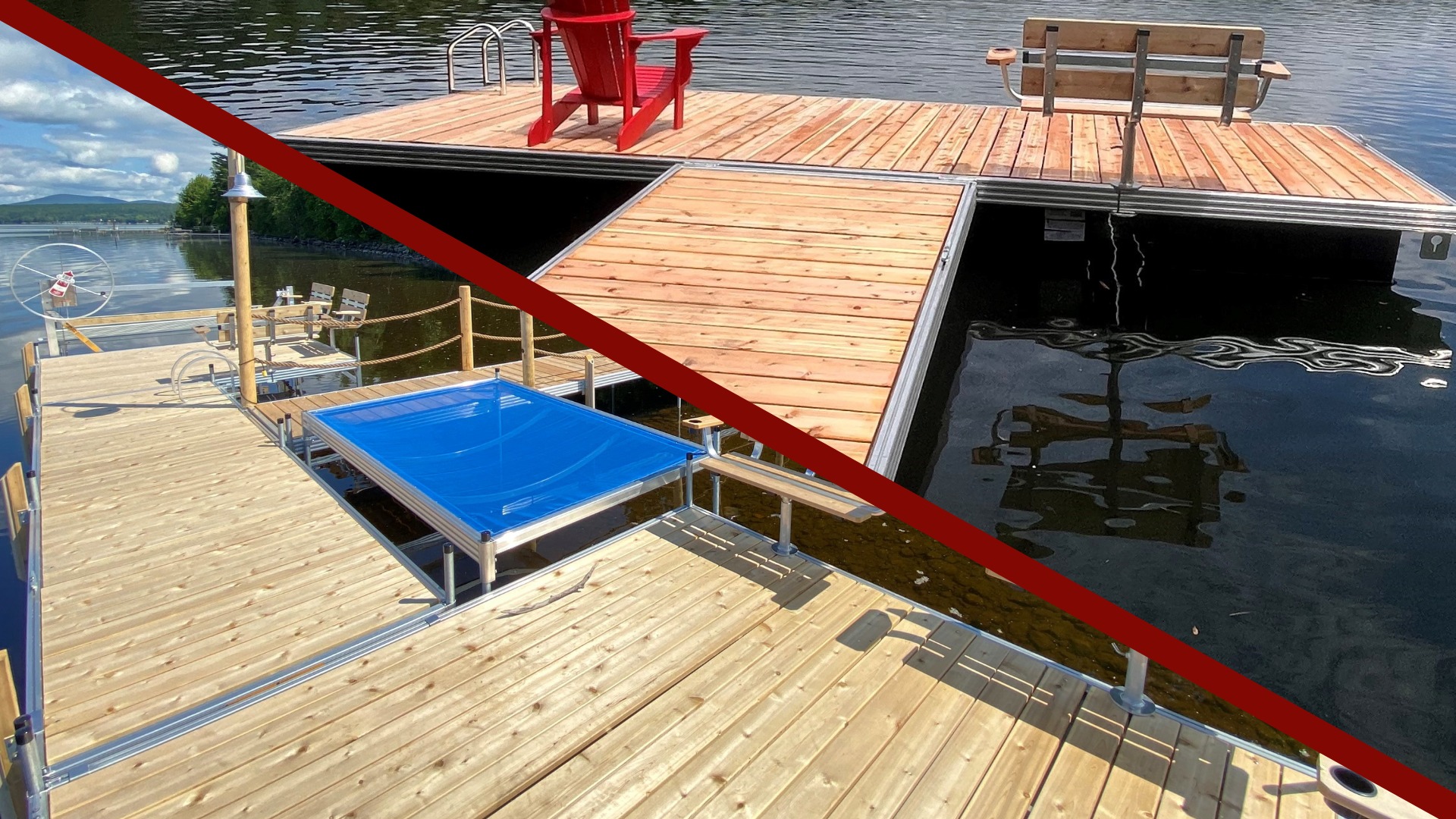

Standing Docks vs Floating Docks: Which Should You Choose for Your Waterway?
Choosing between a standing dock and a floating dock may seem simple… until you realize that every body of water comes with its own challenges. Water depth, water level fluctuations, wind exposure, type of watercraft, and even shoreline layout all directly influence which system is best. We’re here to break it all down, provide a complete comparison, and help you make the right choice.
At The Lighthouse Docks, we install docks across Quebec, Ontario, the Maritimes, and the United States. In other words: we’ve seen it all, and we know exactly what works in each situation.
Here is a complete guide to choosing between a standing dock and a floating dock, based on the real conditions of your waterway.
When to Choose a Standing Dock
A standing dock, also known as a on-post dock, is often the ideal solution when water conditions allow. It is the most stable and durable structure in the majority of cases.
Ideal Conditions for a Standing Dock
A standing dock is recommended if:
• Water depth is less than 6 feet (1.8 m).
• Water levels remain relatively stable throughout the season.
• Site access allows the dock to be removed each year.
Advantages of a Standing Dock
✔ More economical
For an equivalent surface area, a standing dock generally costs less than a floating system.
✔ Simplified installation and removal
With a lightweight aluminum structure, like those from The Lighthouse Docks, dock sections are easy to handle.
✔ Unmatched stability
No rocking. No movement.
Ideal for:
• young children
• anglers
• people with reduced mobility
• lounge chairs and relaxation
✔ Compatible with boat lifts
A standing dock allows for the installation of a boat lift, protecting your boat from waves, wind, and long-term wear.
In Summary
If your lake is calm and shallow, a standing dock is almost always the best choice.
When to Choose a Floating Dock
A floating dock is not a “default” solution—it is a specialized solution for waterways where a standing dock is not feasible.
Conditions That Justify a Floating Dock
A floating dock becomes essential if:
• Water depth exceeds 6–7 feet before reaching the desired length.
• Water levels fluctuate significantly (2 feet or more).
• The waterway is affected by fluctuations caused by a dam or current.
• The lakebed is too soft or unstable to support pilings.
Advantages of a Floating Dock
✔ Works in very deep water
20 feet of water or more? No problem.
✔ Automatically adjusts to water level changes
Regardless of fluctuations, the dock always stays at the correct height.
⚠️ Warning: Improper chain adjustment can cause damage or even allow the dock to drift.
✔ Installation without pilings
Ideal for sites that cannot be stabilized otherwise.
Disadvantages of Floating Docks
While essential in certain environments, floating docks do have some limitations.
Reduced stability
The dock moves constantly due to:
• wind
• waves
• current
• passing boats
This makes it less ideal for relaxing or for families with young children.
Anchoring is mandatory
Proper anchoring requires:
• heavy anchor blocks
• precise positioning
• seasonal adjustments
Less optimal boat mooring
Without a boat lift, your boat is:
• more exposed to waves
• more likely to rub against the dock
• less protected over time
So, which dock should you choose?
Here’s a quick summary:
|
Situation |
Standing Dock |
Floating Dock |
|
Less than 6’ of water depth |
✔ Ideal |
✖ Not recommended |
|
Water level fluctuations |
✖ Not recommended |
✔ Excellent |
|
Calm lake, minimal movement |
✔ Very stable |
✔ Possible, less stable |
|
Wind- / wave-exposed site |
✔ Very stable |
✖ May be unstable |
|
Need for a boat lift |
✔ Perfect |
✖ Not recommended |
|
Deep water (7’+) |
✖ Not recommended |
✔ Recommended |
Our Expert Recommendation
At The Lighthouse Docks, we generally recommend a standing dock whenever conditions allow, because it is:
• more stable
• more durable
• more economical
• compatible with boat lifts
However, when a lake is too deep, too unstable, or subject to major water level variations, a floating dock becomes the optimal solution—provided it is well designed and properly anchored.
Still unsure?
Send us a photo of your shoreline along with the approximate water depth a few feet from shore, and our team will tell you which dock type is optimal for YOUR waterway.